Two Million-Dollar Gifts Propel Research into the Promise of Psychedelics at St. Joe's
Canada NewsWire
HAMILTON, ON, Oct. 2, 2026
The first two philanthropic investments in the hospital's new Centre for Health Innovation and Research in Psychedelics total $2 million — $1 million each from Hamilton philanthropist Teresa Cascioli and the trustees of The Juravinski Foundation
HAMILTON, ON, Oct. 2, 2026 /CNW/ -- Last fall, St. Joseph's Healthcare Hamilton launched the Centre for Health Innovation and Research in Psychedelics (CHIRP), led by Dr. Anthony Adili, the Centre's Founding Director and the Hospital's Chief Innovation Officer. The Centre is designed to ethically and responsibly study whether carefully dosed, medical-grade psychedelics can help treat some of the most challenging health conditions — including chronic pain, addiction, treatment-resistant depression, post-traumatic stress disorder (PTSD), and neurodegenerative diseases. Psychedelics are also showing great promise in treating women's mental health concerns related to hormonal fluctuations during perimenopause and menopause as well as helping terminally ill cancer patients facing existential crises related to their diagnoses.

Today the Centre announced two remarkable gifts to advance that research. Hamilton entrepreneur and philanthropist Teresa Cascioli and the trustees of The Juravinski Foundation each announced gifts of $1 million. The $2 million total will help this innovative Centre establish its physical footprint through dedicated treatment spaces at the hospital and in the community while recruiting the research staff needed for a growing number of Health Canada endorsed clinical trials.
"It's time to leave the decades-old stigma associated with psychedelics behind and look ahead to what the science is showing — particularly in areas where traditional treatments have fallen short for many sufferers," says Dr. Adili. "We know potential and promise are not enough. That's why we're producing rigorous evidence to guide clinicians, patients and policymakers. Our goal is to turn hope into evidence, and evidence into care. These two gifts move us closer, and they move us faster."
CHIRP Researchers are Leading Three Clinical Trials
An Alternative to Opioids: Psychedelics and Chronic Pain
Dr. Anthony Adili, orthopaedic surgeon and CHIRP's Founding Director, is leading a randomized, double-blind clinical trial testing whether carefully dosed psilocybin can relieve chronic musculoskeletal pain that has not responded to standard treatments, including in patients on long-term opioid therapy. The study measures both pain relief and potential reductions in opioid use.
Psilocybin for Cannabis Use Disorder: A First Clinical Test
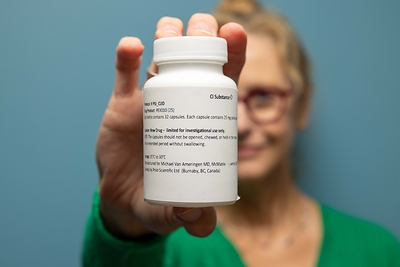
Dr. Michael Van Ameringen and Dr. James MacKillop are investigating whether a natural psychedelic compound found in mushrooms and called psilocybin, when combined with psychotherapy can safely help people with moderate-to-severe cannabis use disorder reduce their symptoms. The scientific rationale is that psilocybin may temporarily loosen deeply entrenched habit circuitry for compulsive cannabis use and open a window during which psychotherapy has a far better chance of being effective, with very promising early findings. This work is a collaboration between the Michael G. DeGroote Centre for Medicinal Cannabis Research and CHIRP.
Testing Psilocybin for Cannabis Use Disorder as Part of a National Initiative
Drs. Van Ameringen and MacKillop are also leading a $2.4 million Canadian Institutes of Health Research (CIHR) funded project to extend promising early findings from the aforementioned study as part of the national Canadian Cannabis and Brain Health Consortium. A key component will be a randomized controlled trial of psilocybin for cannabis use disorder designed to move from early clinical investigation towards national-scale evidence gathering.
Fuelling the Science of Psychedelics Through Philanthropy
Teresa Cascioli says she hopes her donation will help those who have been living with chronic pain to find relief. "Millions of Canadians are living with chronic pain and it impacts every facet of their daily lives – from their work to their relationships, their sleep, comfort and quality of life. Over the counter medicines often aren't effective and opioids can be habit forming," says Cascioli. "The work that Dr. Adili and his colleagues are doing at CHIRP is groundbreaking in its ability to explore how psychedelics can help those in pain who up until now, have had few other options to find relief. Change means challenging the status quo and I'm happy to invest in research that does just that."
Dr. Julian Dobranowski is a radiologist and Chair of the Board of Trustees of The Juravinski Foundation. About the Foundation's $1 million donation, he says, "Charles and Margaret were well ahead of their time. They were trailblazers in supporting innovative health research. As trustees of their namesake foundation, we're proud to continue their legacy by investing in this promising new Centre and its efforts to address conditions that have a life-long impact on the quality of life of so many people here in Hamilton and around the world."
Longstanding Practices, New Clinical Evidence
This isn't the first time the healing potential of psychedelics has been explored. Some Indigenous Peoples, particularly in parts of Mesoamerica, have longstanding traditions involving naturally occurring psychedelics within specific ceremonial, spiritual, and healing practices. Western pharmacology began investigating psychedelics in the 1930s. But the drug subculture of the 1960s brought public concern and criminalization that stalled research for decades.
"With academic interest in psychedelics rising since the early 2000s, St. Joseph's Healthcare Hamilton is proud to be at the forefront of this next chapter in medicine as we pioneer the future of psychedelic-assisted therapies," says Dr. Lehana Thabane, Vice-President, Research, St. Joseph's Healthcare Hamilton. "St. Joe's is an established leader in mental health and addictions, chronic pain, neurology, gastrointestinal disease, surgery, and palliative and cancer care and we bring decades of world-class clinical trial expertise with a commitment to safety. St Joe's is the safest and best-equipped hospital in Canada to research how psychedelics can revolutionize patient care."
Dr. Adili sees the Centre's work as pointing toward something larger than any single trial. "What excites me most is not one drug or one study. It's what this could mean for how we care for patients," he says. "We are talking about a fundamentally different way of treating people — working on what drives the condition rather than managing symptoms indefinitely. St. Joe's can lead the world in this field, and the people waiting on these answers deserve nothing less than our very best."
About St. Joseph's Healthcare Hamilton & Foundation
St. Joseph's Healthcare Hamilton (St. Joe's) is a leading acute care, research and academic health sciences centre renowned for its expertise in mental health and addictions, respiratory care, kidney and urinary care, robotic surgical services, cancer surgery and women's and infant's care, provided at its three main campuses. St. Joseph's Healthcare Foundation fuels the Hospital's excellence in patient care, research, and education by working with our generous community of donors, grateful patients and friends to raise funds to advance the future of care. Learn more at www.stjoes.ca and www.stjoesfoundation.ca.
About the Centre for Health Innovation and Research in Psychedelics
Launched in November 2025, the Centre for Health Innovation and Research in Psychedelics (CHIRP) at St. Joseph's Healthcare Hamilton is one of only a handful of centres worldwide dedicated to advancing the science of medicinal psychedelics. In partnership with McMaster University, CHIRP serves as a national and international hub for research, bringing together experts in psychiatry, neurology, surgery, anesthesia, psychology, neuroscience, imaging, ethics, health research methods, and clinical care. The Centre studies whether carefully dosed, medical-grade psychedelics can help people living with conditions that often remain difficult to treat, including chronic pain, mental health disorders, addictions, neurodegenerative diseases, gut-brain conditions, and the distress associated with cancer and end-of-life or palliative care. Learn more about the Centre: Centre for Health Innovation and Research in Psych | CHIRP

SOURCE St. Joseph's Healthcare Foundation

